Kamis, 31 Mei 2012

Psychology Of Fraud: Why Good People Do Bad Things

From a National Public Radio broadcast by Chana Joffe-Walt and Alix Spiegel

Enron, Worldcom, Bernie Madoff, the subprime mortgage crisis.

Over the past decade or so, news stories about unethical behavior have been a regular feature on TV, a long, discouraging parade of misdeeds marching across our screens. And in the face of these scandals, psychologists and economists have been slowly reworking how they think about the cause of unethical behavior.

In general, when we think about bad behavior, we think about it being tied to character: Bad people do bad things. But that model, researchers say, is profoundly inadequate.

What causes unethical behavior? — has been getting a fair amount of attention from researchers recently, particularly those interested in how our brains process information when we make decisions.

And what these these researchers have concluded is that most of us are capable of behaving in profoundly unethical ways. And not only are we capable of it — without realizing it, we do it all the time.

Over the past couple of decades, psychologists have documented many different ways that our minds fail to see what is directly in front of us. They've come up with a concept called "bounded ethicality": That's the notion that cognitively, our ability to behave ethically is seriously limited, because we don't always see the ethical big picture.

One small example: the way a decision is framed. "The way that a decision is presented to me," says Ann Tenbrunsel, a researcher at Notre Dame, "very much changes the way in which I view that decision, and then eventually, the decision it is that I reach."

Essentially, Tenbrunsel argues, certain cognitive frames make us blind to the fact that we are confronting an ethical problem at all.

Tenbrunsel told us about a recent experiment that illustrates the problem. She got together two groups of people and told one to think about a business decision. The other group was instructed to think about an ethical decision. Those asked to consider a business decision generated one mental checklist; those asked to think of an ethical decision generated a different mental checklist.

Tenbrunsel next had her subjects do an unrelated task to distract them. Then she presented them with an opportunity to cheat.

Those cognitively primed to think about business behaved radically different from those who were not — no matter who they were, or what their moral upbringing had been.

"If you're thinking about a business decision, you are significantly more likely to lie than if you were thinking from an ethical frame," Tenbrunsel says.

According to Tenbrunsel, the business frame cognitively activates one set of goals — to be competent, to be successful; the ethics frame triggers other goals. And once you're in, say, a business frame, you become really focused on meeting those goals, and other goals can completely fade from view.


Now if these psychologists and economists are right, if we are all capable of behaving profoundly unethically without realizing it, then our workplaces and regulations are poorly organized. They're not designed to take into account the cognitively flawed human beings that we are. They don't attempt to structure things around our weaknesses.

Some concrete proposals to do that are on the table. For example, we know that auditors develop relationships with clients after years of working together, and we know that those relationships can corrupt their audits without them even realizing it. So there is a proposal to force businesses to switch auditors every couple of years to address that problem.

Another suggestion: A sentence should be placed at the beginning of every business contract that explicitly says that lying on this contract is unethical and illegal, because that kind of statement would get people into the proper cognitive frame.

And there are other proposals, of course.

Or, we could just keep saying what we've always said — that right is right, and wrong is wrong, and people should know the difference.

Senin, 28 Mei 2012

Insurance News - Monday, May 28, 2012

Quality of Website Can Make or Break Auto Insurance Sale

A good customer website experience can lead to increased sales and recommendations for auto insurers, but a poor website experience can drive consumers away, says a J.D. Power study.

The Westlake Village, Calif.-based information-services company released its 2012 Insurance Website Evaluation Study yesterday, which indicates that with 34 percent of auto-insurance consumers preferring to shop online, the website experience “impacts the likelihood to shop and recommend the insurer” to others.

According to the study, of consumers who said they were “delighted” with their website experience, 63 percent say they are more likely to shop with that insurer.

Conversely, of consumers who were disappointed with their experience, just 14 percent say they were likely to shop with the insurer.

read more...


Consumers Think Beyond Price; Not Interested in Online-Only Experience

Consumers do not want to do all their insurance shopping online, they care about more than just price, and good claims service is something consumers expect, rather than an extra bonus that will help a company’s retention rate, according to the findings of an Ernst & Young survey.

The survey polled 24,000 respondents across 23 countries. E&Y breaks down the results for the Americas respondents in a report, “Voice of the Customer: Time for Insurers to Rethink Their relationships.”

read more...

Rehabilitation Clinics, Owners and Directors Face 15 Charges Related to Submitting False Invoices

The Financial Services Commission of Ontario (FSCO) has charged five rehabilitation clinics and 10 individuals affiliated with these clinics with offences under Ontario’s Insurance Act.
The following clinics were charged with one count each of knowingly making false or misleading statements to an auto insurer to obtain payment for goods or services provided to an insured and engaging in an unfair or deceptive act or practice:
  • Professional Medexam Management Inc. (2414 Major MacKenzie Drive, Maple ON)
  • Assessment Direct Inc. (2888 Bathurst St., Toronto ON)
  • Century Diagnostics Inc. (37 Kodiak Crescent, Toronto ON)
  • Evident Diagnostics Inc. (160 East Beaver Creek, Richmond Hill ON)
  • Supermed Rehabilitation Centre Inc. (7777 Kipling Avenue, Woodbridge ON)
The following individuals, affiliated with a clinic as a director, were also charged with one count each of failing to take reasonable care to prevent the corporation from making false statements to an insurer and from engaging in an unfair or deceptive act or practice:
  • Mark Zinger
  • Yan Krivoruk
  • Alex Smolar
  • Paul Benchetrit
  • Pavlo Tsysar
  • Ivan Terziev
  • Vladimir Naidenov
  • Alla Pechenik
  • Eugene Gurevich
  • Valeri Znamenski
On May 24, 2012, these individuals and corporations were summonsed to appear in the Ontario Court of Justice.

Senin, 21 Mei 2012

Insurance News - Monday, May 21, 2012

NY to Boot Crooked Doctors From No-Fault Insurance

Insurance regulators plan to start kicking crooked doctors out of New York's no-fault program next month, calling them linchpins in fake-accident scams that cost insurers and ultimately policyholders hundreds of millions of dollars.

Regulations are set to take effect June 12. The Department of Financial Services sent certified letters in March to 135 doctors, chiropractors, acupuncturists and physical therapists, demanding they explain suspect billing patterns and threatening to remove them from the program if they don't respond.

read more here...

Driver Qualifies for Benefits Despite Driving Vehicle Without Owner's Consent

A Financial Services Commission of Ontario (FSCO) arbitrator has ruled a 17-year-old driver who suffered serious injuries in an accident should receive non-earner benefits even though it is alleged he was driving a car without the owner’s consent.

The main issue in the arbitration of R.P. and Intact Insurance Company was whether or not the driver, who was not named because of his status as a minor, could “reasonably have known that he lacked consent to drive the 1998 Lincoln.”

R.P. had regularly driven the car, which was owned by a family with which he lived. R.P. was seriously injuried in the The vehicle owner's testimony was determined not be be reliable and that R.P. was not allowed to drive the car. That being the case, the arbitrator ruled it was reasonable for him to assume R.P. had consent on the night of the accident, April 11, 2009.

read decision here...

Rabu, 16 Mei 2012

Insurance News - Wednesday, May 16, 2012

Ontario Drivers Satisfied With Their Auto Insurance

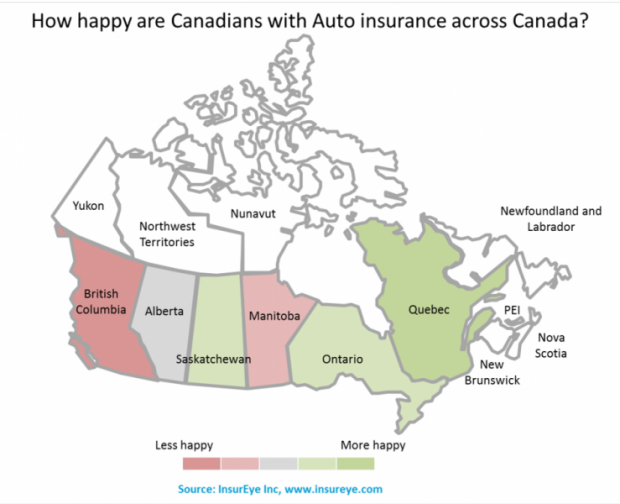
Auto insurance isn’t everyone’s favourite monthly expense, but just how do Canadians feel about the subject? Canadian company InsurEye Inc. has completed an auto insurance consumer satisfaction survey to answer the question: “How do Canadians feel about auto insurance and which provinces have the most critical consumer perspective?”

The most critical attitude towards auto insurance is in British Columbia. The most positive attitude towards auto insurance was registered in Quebec, closely followed by Ontario and Saskatchewan.


The survey suggests that auto insurance stakeholders in Ontario may be exaggerating consumer unhappiness with the 2010 reforms. Consumers are positive about claims experience but negative about value for money despite the fact that rates have stabilized. The reforms have not produced much in the way of lower rates after two years of increases. Rates remain the highest in Canada.

read more...


Texas Turning Up the Heat on Fraudsters

The heat is getting turned up on fraudsters in Texas as the state’s Department of Insurance is backing the designation of a second county insurance fraud prosecutor and investigator with the aim of adding more in the future.

The Texas Department of Insurance (TDI) has agreed to pay for a new insurance fraud prosecutor and investigator at the Harris County District Attorney’s Office.

read more...

Allstate Files $6 Million Insurance Fraud Case

Allstate Insurance Company has filed its second insurance fraud lawsuit of 2012, seeking to recover $6 million against 4 New York area defendants. The Complaint names a physician, a medical professional corporation, a management company, and an unlicensed layperson who allegedly used his management company to control at least one medical professional corporation.


The Allstate action is similar to civil suits filed against Toronto health care facilities by a number of Ontario insurers.

read more...

Senin, 14 Mei 2012

Interest on Overdue Amounts for Accidents Before September 1, 2010

An arbitration decision that should be of interest to all parties is Federico vs. State Farm. Mr. Federico's accident occurred prior to September 1, 2010 when reforms became effective in Ontario. One of the issues in dispute was the amount of interest to be paid to Mr. Federico on overdue benefit payments.

On September 1, 2010 the amount of interest paid was reduced from 2% per month compounded monthly to 1% per month compounded monthly.

The transition provisions in the new SABS (section 2 of Ontario Regulation 34/10) state that "Parts VIII and IX...apply with such modifications as necessary in respect of benefits provided under the Old Regulation with respect to accidents that occurred on or after November 1, 1996 and before September 1, 2010." The section dealing with overdue amounts is found in Part IX of new SABS.

An analogous amendment was made to the old SABS (section 3 of Ontario Regulation 403/96) stating that "Parts X, XI, XII, XIII and XV do not apply after August 31, 2010." The section dealing with overdue amounts is found in Part X of the old SABS.

On April 26, 2010, the Superintendent issued a bulletin (A-04/10) covering the transition to the new SABS. The bulletin stated that as of September 1, 2010, as a general rule the new SABS will govern claims processing relating to old accidents and the determination of amounts payable by insurers on account of expenses paid to establish benefit entitlements arising out of old accidents. One of the examples provided in the bulletin was that interest on amounts that become overdue on or after September 1, 2010, in respect to old accidents, will accrue at the new SABS rate of 1% per month compounded monthly.

The bulletin went on to provide some exceptions to the general rule and included interest on amounts that become overdue before September 1, 2010, in respect to old accidents, will accrue at the old SABS rate of 2% per month and be compounded monthly both before and after September 1, 2010. That means that an amount that is overdue prior to the reforms continues to accrue interest at the same rate. The rate for these overdue amounts does not change on September 1, 2010. However, the intent of the SABS was that new overdue payments (for example delayed payment for treatment provided after September 1, 2010) falls under the new SABS and the new interest rate.

So it is not surprising that the arbitrator ruled that the interest rate that applied to overdue amounts in this claim was 2% for the periods before and after September 1, 2010. This was consistent with the direction provided by the Superintendent in his bulletin.

Selasa, 08 Mei 2012

How Should Insurers React to Parveen vs. Aviva / Fredric vs. Aviva?

FSCO released Preliminary Decisions in two cases Parveen vs. Aviva and Fredic vs. Aviva both dated March 30, 2012 in which an arbitrator determined that both insureds had rescinded a settlement with Aviva Canada thus allowing Ms. Parveen and Mr. Fredric to proceed to arbitration.

In this particular case the arbitrator had agreed with the insureds that Aviva had failed to comply with the requirements of the Settlement Regulation, and she was entitled to rescind the agreement after the two-day period, in accordance with ss. 9.1(5) of the Settlement Regulation. The arbitrator was of the opinion that the Settlement Disclosure Notice was did not comply with the Settlement Regulation.

These decisions are the cause of considerable frustration within the system. The Settlement Disclosure Notice has been in effect since September 2010 and prior to that a very similar notice form was being used for years. The form is approved by the Superintendent of Financial Services following considerable involvement by both Dispute Resolution and Legal staff at FSCO and insurers and counsel representing insureds and insurers. In light of this, the arbitrators decision makes no sense.

Still these cases are relatively unique. A Settlement Disclosure Notice was executed. Over a month later a Release was executed. Following which the insurer received a letter rescinding the settlement. Settlement funds were then forwarded, and then returned.

Since the decisions have come out FSCO has posted a notice on its website stating that it is the Superintendent’s position that the current version of the Settlement Disclosure Notice form complies with the Regulation.

So how should insurers proceed in light of the decisions and the Superintendent's position?

I'm not so sure that revising he form will provide much additional protection. The Settlement Disclosure Notice is adequate. There will always be a risk that an arbitrator will make a similar ruling in the future. Insurers need to ensure that insureds understand the Settlement Disclosure Notice and the settlement process. Insurers who are concerned that they may not be providing sufficient disclosure should consider providing information additional to improve claimant communication and enhance the settlement process.

It would be a good idea to execute Releases first or at the same time as the Settlement Disclosure Notice. A Release terminates an insurers obligation to pay accident benefits which can be argued is not accomplished by the Settlement Disclosure Notice.

Rabu, 02 Mei 2012

Insurance News - Wednesday, May 2, 2012

Why Fewer Car Thefts Doesn’t Mean Cheaper Car Insurance

Dramatic declines in car theft will not likely translate into cheaper car insurance, drivers may be sad to learn.

Diligent police work and new anti-theft devices have cut thefts by half, or about 9,800 cars per year in the Greater Toronto Area, for instance.

But when it comes to insurance, nearly a third of all car owners already pay nothing because they have no theft coverage, and those who do, pay very little for it.

The average premium for what’s called comprehensive coverage — for everything from theft to broken glass — was only $107 per car in Toronto, Peel and southern York regions in 2010, down from $134 in 2006.

read more...

Auto Insurance Rates Stabilizing


The average auto insurance premium in Ontario declined slightly last quarter – a sign that rates may finally be stabilizing after years of sky-high increases.

The Financial Services Commission of Ontario, the body that regulates auto insurance, said the average premium fell 0.18 per cent.

read more...

Ontario Sees Average Car Insurance Rates Go Down 3.6%

Ontario witnessed the largest reduction in car insurance rates among the three provinces considered in Kanetix Ltd.’s latest quarterly, year-over-year review.

Customers saw rates go down 3.6% compared with 2011 Q1, notes a statement from Kanetix, an online insurance marketplace. Suggesting an early positive trend fueled by Ontario’s auto reforms in 2010, the decrease is the first in more than a year.

read more...

FSCO's Settlement Disclosure Notice May Be Inadequate

A FSCO Arbitrator has ruled that the FSCO prescribed Settlement Disclosure Notice might be inadequate to effect settlement. In Parveen vs. Aviva, a preliminary issue was whether Ms. Parveen had rescinded her accident benefits settlement and was entitled to move to arbitration.

The Arbitrator found that important information in the Settlement Regulation was not conveyed by the text of the prescribed Settlement Disclosure Notice. Specifically, she noted that Paragraph 3 of subsection 9.1(3) of Ontario Regulation 664 sets out the information that must be included in the disclosure notice with respect to the right to rescind a settlement. It requires:

A statement that the insured person may, within two business days after the later of the day the insured person signs the disclosure notice and the day the insured person signs the release, rescind the settlement by delivering a written notice to the office of the insurer or its representative and returning any money received by the insured person as consideration for the settlement.

The arbitration decision is here.